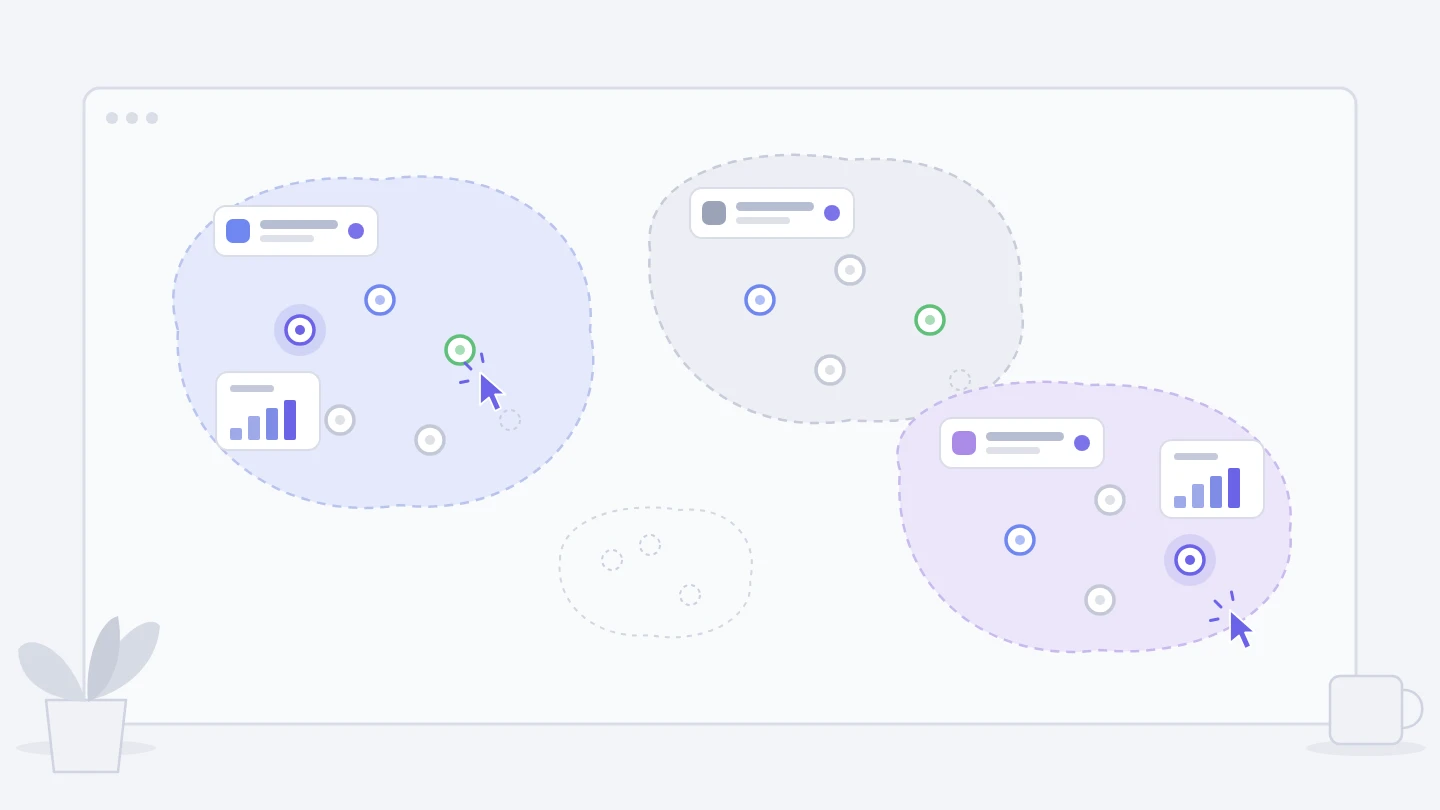
One colleague asks an Agent to revise an invitation page, another prepares the registration sheet, and you check the event details. Three separate chats can get this done, but make it harder to see the whole picture. Dynamic view puts those chats on one map: each group is a patch of land, and each conversation a dot on it, so the team keeps the whole picture.
The map shows work and provides a way into it. Requirements, discussions and results still live in their original chats. Two conversations on the same land do not automatically hand work between Agents or decide who owns a task.
Start with real work
Join a workspace first. Owners and editors can start chats and organize groups; viewers can inspect and locate existing work. Start with two or three chats that have clear goals, rather than an empty organization chart. See Work together for invitations and roles.
Choose “Dynamic view” in the sidebar. It uses the same chats as the chat list, so there is no need to copy messages. “New chat” at the bottom starts the next piece of work; rest the pointer on it a moment to pick the group the chat goes into, or to make a new group for it.
- See the wholeGroups, people and running Agents
- Find what needs youApprovals, results and mentions
- Enter the workOpen the conversation and continue
The diagram moves from seeing the whole project to finding what needs attention and entering the work. Put parallel tasks such as content, design and registration in different groups. “Needs you” at the upper left belongs to the person currently signed in. Use groups to find an area, then attention items to find an action, instead of opening every chat.
See the same work from another angle
The “View” switcher at the top on desktop offers “Map,” “Timeline,” and “People & Agents.” On a phone, find “View” in the bottom “More” menu. When you are not typing in a field or holding Ctrl, Command, or Alt, press 1, 2, or 3 to switch to these views respectively.
- Map lays the conversations out as land, one patch per group, so you can see who is active and who is waiting in each direction of work.
- Timeline shows conversations active within the last 14 days, arranged by group. Bars are drawn from creation to the latest activity; they do not mean an Agent ran continuously for that period. Click a bar to open the conversation, or a group name to return to that group on the map.
- People & Agents arranges rows by who started each conversation, with your own row first, so you can review active conversations and recent results. This shows who initiated the work, not every participant in each conversation.
Your view is a personal preference. Switching it does not change anyone else’s view or the groups.
Read the map
Nobody places anything on the map: positions follow from the groups and conversations, so every member sees the same map. Each patch of land takes its group’s color, and its name plate shows the group’s name, how many conversations wait on you or are running, and a line from Ghost on where the work stands. Pinch on a trackpad to zoom; drag empty ground to pan. Zoomed out, only the plates remain; click one to enter its group, then zoom in to read each conversation’s title and state. The running count at the upper right shows how many chats currently have an Agent at work.
Each conversation is a dot on the land, and the dot shows its state: waiting for your approval, someone mentioned you, running, waiting for someone else’s approval, a result you have not seen, stuck, or waiting for a reply. Click it for its card; double-click, or open from the card, to enter the conversation itself. The right-click menu opens its discussion, calls colleagues over, renames it, moves it to another group or archives it.
A conversation quiet for three days sinks under the land and leaves only a faint mark; one that is running, waits on you or has a result you have not seen never sinks. When all of a group’s conversations have sunk, its land shrinks to a one-tile ruin at the edge of the map, its sign saying when they sank. The dozen conversations that moved most recently always stay above ground, so a quiet workspace is never bare. Sunken conversations are still there: the group’s card lists them, and opening one takes you back to the moment it last moved, or straight into the conversation.
The map remembers the last four weeks. Drag the time ruler to go back to a day and see what was above ground then; press T to stand the map on end, one glass sheet per week with now on top, and click a sheet to go back to that week; press 0 to return to now. This is looking back; it changes nothing in any conversation.
Groups: organize by direction of work
A group names a direction of work, such as “Event website” or “Registration data,” using names the team has already agreed on. In the panel’s chat list at the upper left, each group lists its conversations, those going on first and the folded ones after. Click a group’s name to rename it, change its color or write its goal, jump to its land on the map, or dissolve it. Color helps recognition; it does not grant ownership or permissions.
A new chat is filed into a fitting group once it has a title. Conversations in no group share the “Ungrouped” land; right-click that land and choose “Organize these chats by direction of work,” and an Agent files them into existing or new groups. The result can be undone in one click. A workspace with no groups yet is organized once on its own when it has enough conversations, so the map is never one grey patch. You can also move conversations into groups one by one, or choose the group when starting a chat.
Groups are shared. Renaming, recoloring and dissolving change the map for every member; dissolving only returns the conversations to the ungrouped land and deletes nothing. When a group’s last conversation is archived or moved out, the group goes with it.
Check “Needs you” first
“Needs you” is calculated for each member, rather than sending the entire team’s reminders to one person. It collects three kinds of item: an execution you started needs your approval; work you started has a recent result awaiting attention; or someone mentioned you in a discussion. Result reminders cover qualifying results from the past three days, with each chat listed once.
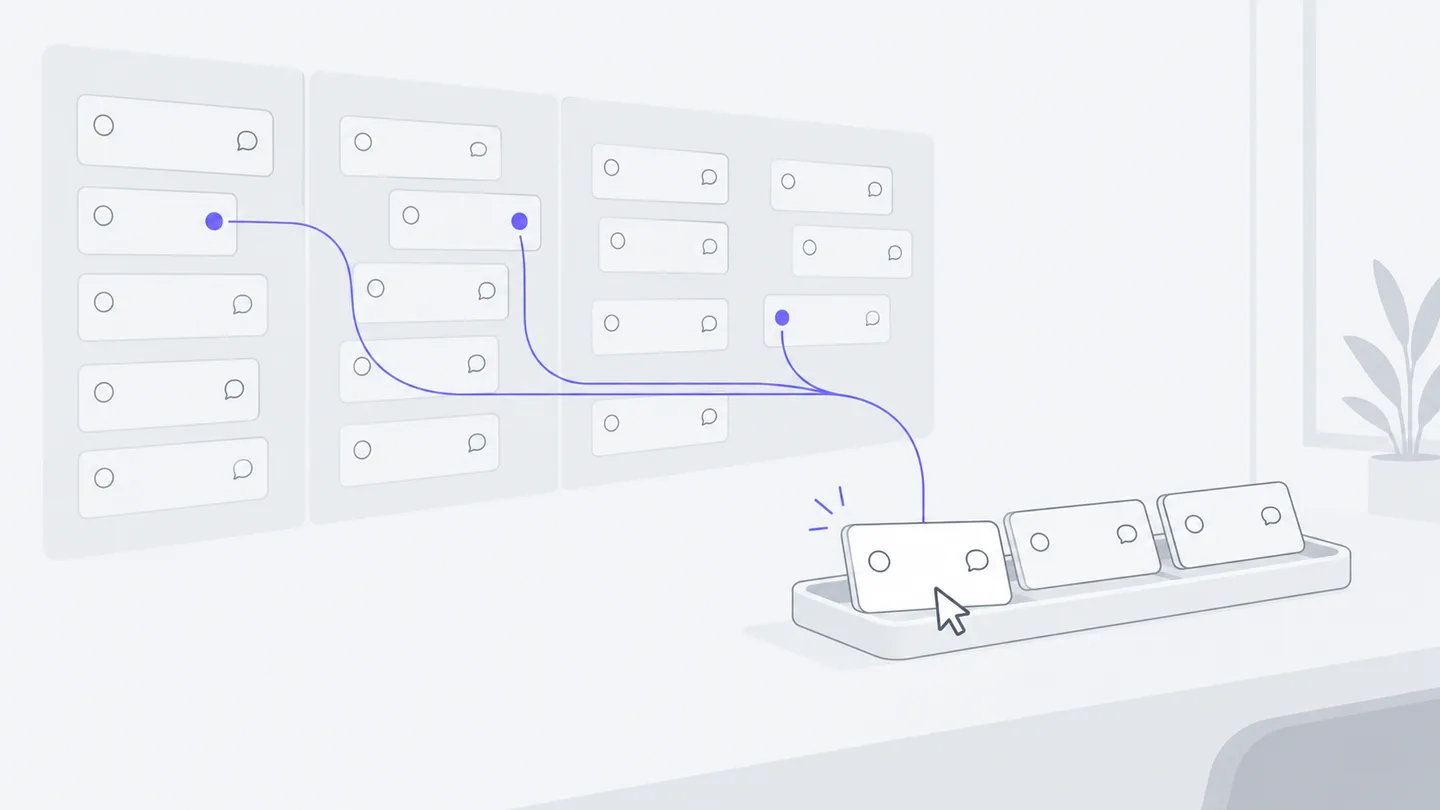
The panel initially shows five items. Open the “more” entry to see the rest. Selecting an item brings the conversation into view on the map, or opens the chat if it has sunk. A conversation you cannot see on the map does not mean nothing needs attention. “Show me” flies through them one by one, and each counts as seen on arrival.
Press J for the next item and K for the previous one. These shortcuts do not run while you are typing in a text field or holding Ctrl, Command or Alt. Review results in sequence, then return to the chat that needs a specific response.
“Mark as seen” only takes that reminder off the list. It does not approve a tool action, complete the task or silence future reminders from the chat. Do not use it as an acceptance button before checking the result. Handle approval, replies and requested changes in the relevant chat.
Coordinate people and Agents
Members looking at the map now appear at the upper right. Click one, and the conversations that concern them stand out while the rest go quiet. Beside each conversation is its discussion; mention a colleague or call them over to bring them to that conversation. These mark places on the map; they are not file locks and do not mean someone is editing a file.
Write task boundaries into chats to make the map useful for collaboration. Agree that one colleague owns copy, another owns visuals, and you own review; then put the three Agent chats in one group. During handoff, name the file and expected result instead of saying “the one next to it.”
Check the event information in
weekend-walk/index.html. Review only the date, time, location and registration entry, and list any problems with the relevant text. Do not edit files yet; I will pass confirmed issues to the colleague responsible for the page.
This creates a focused review chat: it identifies the shared result, limits the scope and produces findings someone else can use. If several people need to edit the same file, agree on an order in the discussion before issuing instructions against different versions.
Why conversations become fewer
Dynamic view maintains a current working set. Chats that are running, need the current member’s attention or are pinned stay visible; so do chats someone wrote in during the past three days. Chats quiet for more than three days fold into their group’s collapsed list in the panel and sink under the land on the map; after fourteen days they leave the working set. This tidies the view without deleting history: you can still find the original chat in the chat list. Since each member has different attention items, their working sets may also differ.
Verify with a small exercise
Create or choose three chats, and put them in two groups. Ask a colleague to open the same map and confirm they see the same groups. Each of you should check “Needs you” and understand why the lists need not match. Finally, enter a chat from the map and leave actionable feedback.
If a conversation is missing, check its group, the folded list and the sunken list. If you cannot start chats or organize groups, check your workspace role. The counts on a plate and Ghost’s progress line are an overview, not a project plan with inferred dependencies.
Next, use Plugins to connect Agents to external services so they can read real data.